

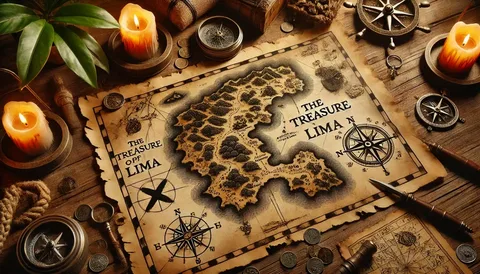
The Treasure of Lima is one of history’s most enduring legends of buried treasure. For more than 200 years, stories of a vast fortune hidden somewhere on Cocos Island have inspired explorers, historians, adventurers, and professional treasure hunters. Despite countless expeditions and millions of dollars spent searching for it, no one has conclusively found the legendary cache.
Whether the treasure truly exists or has become larger than life through generations of storytelling, its mystery continues to captivate people around the world. The tale combines historical events, piracy, betrayal, hidden riches, and an isolated tropical island, making it one of the greatest treasure legends ever told.
The Historical Background
The story begins during the early nineteenth century, when South America was in the midst of independence movements against Spanish colonial rule. Political instability spread throughout the region, causing governments, churches, and wealthy citizens to fear that their valuables might fall into the hands of revolutionary forces.
Lima, Peru, was one of Spain’s most important colonial cities and possessed enormous wealth. Churches contained priceless religious artifacts crafted from gold and silver, while government buildings stored coins, jewels, and precious metals collected throughout the Spanish Empire.
As revolutionary forces approached Lima around 1820, Spanish officials reportedly decided to move these treasures to safety. The fortune was loaded aboard a merchant ship commanded by Captain William Thompson, who was entrusted with transporting the valuables to Mexico for protection.
According to the legend, Thompson and his crew saw an opportunity that few people could resist.
Instead of delivering the cargo, they murdered the Spanish guards aboard the vessel, seized the treasure for themselves, and sailed into the Pacific Ocean in search of a place to hide their stolen fortune.
What Was Included in the Treasure?
No complete inventory has ever been verified, but the legend describes an astonishing collection of valuables.
Stories claim the Treasure of Lima included:
- Thousands of gold and silver coins
- Gold bars and silver ingots
- Precious gemstones
- Diamonds and emeralds
- Elaborately crafted jewelry
- Religious statues made of solid gold
- Ornate chalices and crosses
- Decorative artwork from churches
- Valuable historical artifacts
One of the most famous claims is that the treasure included a life-sized statue of the Virgin Mary crafted entirely from solid gold and decorated with precious gems. While historians debate whether such an object truly existed, it has become one of the defining images associated with the legend.
If the reported inventory were accurate, the treasure would be worth hundreds of millions—or even billions—of dollars today.
The Journey to Cocos Island
The most famous version of the story says Captain Thompson sailed to remote Cocos Island, located hundreds of miles off the Pacific coast of Costa Rica.
At the time, Cocos Island was uninhabited and covered by dense rainforest, making it an ideal place to hide stolen riches.
According to legend, Thompson and his crew buried the treasure somewhere on the island before attempting to leave.
Soon afterward, the ship was captured by authorities searching for the missing Spanish fortune.
Most versions of the story claim the crew was arrested and executed. Before their deaths, however, Thompson and one surviving crew member supposedly offered to lead authorities back to the hidden treasure.
The story takes another mysterious turn here.
The two men reportedly escaped into the jungle of Cocos Island during the expedition and disappeared forever.
Whether they died in the rainforest, escaped by sea, or took the secret of the treasure’s location with them has never been confirmed.
Why Cocos Island Became a Treasure Hunter’s Dream
Cocos Island possesses many characteristics that make it the perfect setting for a treasure legend.
The island features:
- Dense tropical rainforest
- Rugged volcanic mountains
- Hidden caves
- Steep valleys
- Numerous waterfalls
- Freshwater streams
- Remote beaches
- Rocky coastlines
Its challenging terrain makes exploration difficult even with modern equipment.
For treasure hunters, every cave, river, cliff, and valley could potentially conceal the legendary fortune.
Because the island remained largely undeveloped for centuries, many believed the treasure could still be exactly where it was originally hidden.
Countless Expeditions
The Treasure of Lima has inspired hundreds of expeditions over the past two centuries.
Some explorers relied on historical documents.
Others claimed to possess secret treasure maps.
Many followed stories handed down through earlier treasure hunters who believed they had solved part of the mystery.
Search teams have excavated caves, searched river valleys, climbed mountains, and investigated remote beaches across Cocos Island.
Some reported discovering old campsites, rusted tools, or unusual rock formations.
Others believed they uncovered tunnels or hidden chambers.
Despite these claims, no expedition has produced definitive evidence proving the Treasure of Lima has been found.
Why the Treasure Remains So Elusive
Several factors contribute to the mystery surrounding the Treasure of Lima.
First, historians disagree about which parts of the story are factual and which parts are legend.
Historical records confirm that political unrest occurred in Peru during the early nineteenth century and that valuables were removed from Lima. However, many details regarding Captain William Thompson and the disappearance of the treasure remain difficult to verify.
Second, Cocos Island itself presents enormous challenges.
The island receives heavy rainfall throughout much of the year, causing rapid vegetation growth and frequent erosion. Dense rainforest can quickly reclaim disturbed ground, while landslides and flooding constantly reshape the landscape.
A location that existed in 1820 may look completely different today.
Finally, many treasure maps and written clues connected to the legend have uncertain origins. Some may be authentic, while others were likely created decades later to support new treasure expeditions.
Separating fact from fiction has become one of the greatest challenges facing modern researchers.
Theories About the Treasure’s Location
Over the years, numerous theories have emerged regarding where the treasure might be hidden.
Some believe it lies inside one of Cocos Island’s volcanic caves.
Others argue it was buried near a waterfall, where fresh water would have allowed the crew to establish a temporary camp.
Additional theories suggest the treasure rests beneath a mountain ridge, inside a jungle clearing, beside a river valley, or beneath a distinctive rock formation that served as a landmark.
Another possibility is that the treasure never remained on Cocos Island at all. Some researchers believe Captain Thompson later recovered the fortune and transported it elsewhere, while others speculate it was divided into multiple hiding places.
Without definitive evidence, every theory remains open to debate.
The Treasure’s Lasting Legacy
Regardless of whether the Treasure of Lima is ever discovered, its influence extends far beyond the possibility of finding gold.
The legend has inspired:
- Books
- Documentaries
- Adventure novels
- Treasure-hunting expeditions
- Historical research
- Television programs
It has also contributed to Cocos Island’s reputation as one of the world’s greatest treasure destinations.
The story continues to fascinate because it blends real history with enduring mystery. Unlike fictional treasure tales, the Treasure of Lima is connected to genuine historical events, making the possibility of its existence feel just believable enough to keep people searching.
Could the Treasure Still Be Waiting?
After more than two centuries, no one can say with certainty what became of the Treasure of Lima.
Perhaps it remains hidden beneath layers of volcanic soil deep within the rainforest.
Perhaps it lies inside an undiscovered cave that has escaped every expedition.
It may rest beneath an ancient landslide, concealed by centuries of tropical growth, or it may have been removed long ago by someone who chose to keep the secret.
The lack of answers is exactly what keeps the legend alive.
As long as Cocos Island remains cloaked in mystery, explorers will continue to wonder whether one final expedition will uncover the greatest cache of buried treasure ever hidden.
Until that day comes, the Treasure of Lima remains one of history’s most captivating unsolved mysteries—a story of immense wealth, daring betrayal, and the timeless hope that somewhere, hidden beneath an island paradise, a legendary fortune still waits to be discovered.
